


Negotiable Nonsense
Most Major Conflicts Do NOT End with Negotiation
June 2026
“‘You’ve got to be strong, not weak. The only way to deal with these people is to bring them to justice. You can’t talk to them. You can’t negotiate with them.’
George W Bush
“May I make plain my negotiating position? I will not negotiate with criminals or thugs”
Margaret Thatcher
“If you go back to World War II, if you go back to World War I, if you go back to every major conflict in human history, they all end with some kind of negotiation.”
Vice President JD Vance
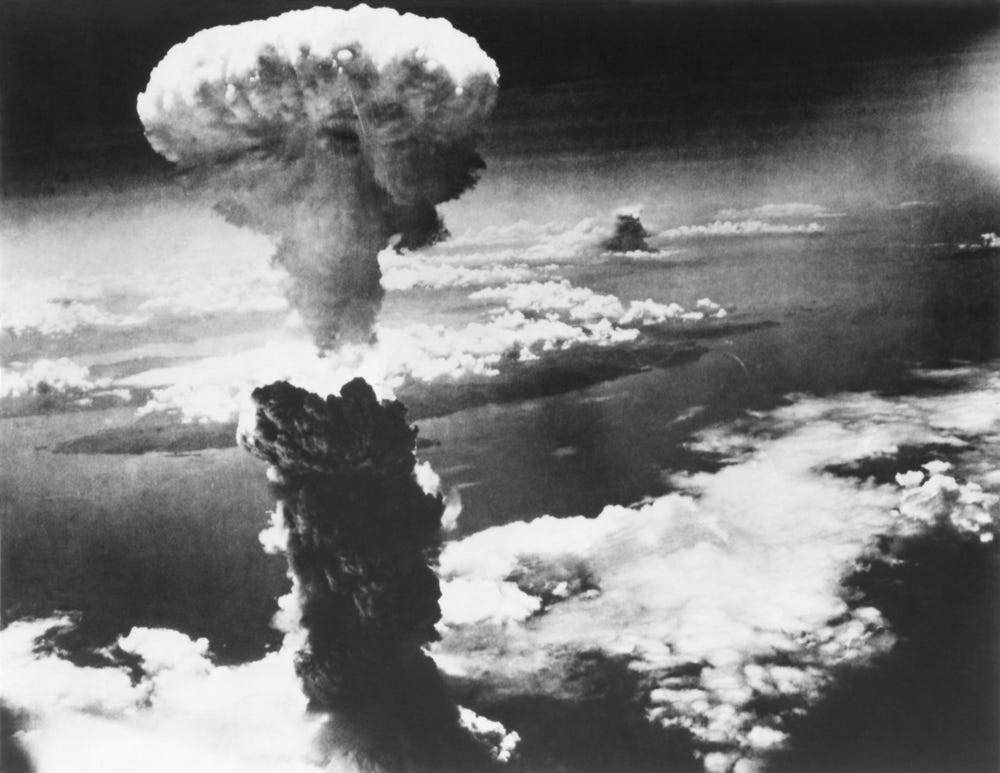
Of course, Vance is wrong. Even excluding historians and history buffs, even those random young people on beaches during spring break that video casters seem to love to ask complex questions, might know that World War 2 ended with the only use of an atomic bomb against an enemy target when dropped on Nagasaki. The Japanese Imperial government unconditionally surrendered, and the nation itself was governed for the next five years by what would have been called a viceroy in an earlier age in the person of Douglas MacArthur. Why Vance was so off on this I will posit later in this piece, but for now, I am more interested in his second contention, which at least is somewhat open to argument.
Every major conflict ended in negotiation? Not so much.
My son shares my name, which is like throwing gasoline on the open flame of my ego. He is highly intelligent but also kind and thoughtful. I wonder if I had given him a, well, tougher name, something like Thor or Sargon. The Akkadians, and their preeminent ruler Sargon, fascinate me because they were the first empire and because their ruler has such a cool name. While the decision wasn’t mine to make (my wife did the work), I don’t have a Sargon Tippet to boast of. That said, the city-states conquered by Akkad in the 23rd and 22nd centuries were not part of any negotiation.
Let’s look at the battle of Megiddo, which took place in 1457 and is reputed to be the first recorded full-scale battle in history. As Paul K. Davis wrote, “By reestablishing Egyptian dominance in Canaan, Thutmose began a reign in which Egypt reached its greatest expanse as an empire.” [15] Thutmose III required the defeated kings to send a son to the Egyptian court. There, they received an Egyptian education. When they returned to their homelands, they governed with Egyptian sympathies. Nevertheless, the victory at Megiddo was only the beginning of the pacification of the Levant. Not much discussion here.
I can provide a fairly extensive list of ancient encounters, ranging from the Persian conquests under Cyrus to Alexander’s conquest of that same empire to the Roman Punic Wars. After the 1st Punic War, there was a sort of negotiation, but in reality, Rome dictated the terms. A decisive Roman naval victory at the Battle of the Aegates Islands bankrupted Carthage and forced it to sign the Treaty of Lutatius in 241 BC. The catastrophic loss of their fleet left Carthaginian forces stranded in Sicily, ending 23 years of grueling conflict.
There is also the 30-year Peloponnesian War, which ended not with negotiation but with a decimated Athens under Sparta’s boot.
In the Middle Ages, the Islamic invasion of the 600s and 700s did not involve much negotiation. And the Mongols were not exactly skilled and deft diplomats either.
There were certainly many peace deals and treaties during the 100-year war between England and France, which was not really a continuous century-long conflict but a series of ups and downs as first one side, then the other gained supremacy. But even that conflict ended decisively in the Hundred Years’ War was the Battle of Castillon on July 17, 1453. Fought in Gascony, France, it resulted in a decisive French victory over the English and marked the effective end of the 116-year conflict.
The Great Northern War, the Seven Years’ War, and the Napoleonic Wars: not one of them ended with both sides simply negotiating, but rather with one side dominant over the other.
I noted World War 2 ended in unconditional surrender, so World War I should be a counterpoint, given the Treaty of Versailles was not the same as the Allies conquering and occupying Germany as they did in the later conflict.
Yet Versailles was not truly a negotiation but rather a dictated list by the English, and even more, the French. By November 1918, the Austro-Hungarian Empire was in chaos, the German High Seas Fleet had mutinied, the German army refused to obey orders, and millions of fresh American troops were pouring into France. Versailles was a one-sided treaty that provided impetus for Adoph Hitler and his Nazi party to stoke grievances among the Germans.
A quick run-through of American conflicts also shows that, by and large, there wasn’t much negotiating. The Americans won the Revolutionary War. The Civil War was unconditional surrender. Both the Mexican American and Spanish American wars ended with treaties, but in both cases, the United States dictated terms. Of all these conflicts, only the War of 1812 and the Korean War ended with a true negotiation. Even Vietnam saw America on the losing side, conceding everything to the North Vietnamese after the collapse of support on the home front for the war.
So why is the ex-Marine, Yale-educated Vance making such an absurd statement? One is tempted to chalk this up to Vance’s foolishness. Perhaps his decisive takedown of Tim Walz in their debate two years ago was a chimera because Walz is such a dunce. I am often loath to call someone an idiot who managed to get elected to Congress and to two terms as governor of a state. But Walz is an idiot. Yet Vance has shown too much cleverness over time. From the publication of his Hillbilly Elegy to obtaining a lucrative job in a hedge fund and successful runs for the Senate and Vice President, his resume is too good to compare him, even remotely, to the likes of Walz. And even his wife, Usha. She seems to actually like America, unlike Michelle Obama; is comfortable seen next to her husband, unlike the current First Lady; and does not seem to possess the same overweening desire for the white-hot spotlight of Jill Biden, sorry, Dr. Jill Biden. So what is up with the Vance ignorance?
Three reasons why he is making easily refutable claims: first, he is doing what good Veeps do and carrying water for the boss. Putting a false patina on what is looking more and more like an Iranian victory is part of the job. The second is that Vance is being forced into the position. As the Biden staff did to Harris, Vance is being tied to a no-win scenario in negotiating with a lying bunch of terrorists who represent some of the greatest scum of humanity. The Mullahs are never to be trusted. And he is negotiating on behalf of Trump, one of the most inconstant figures in recent American politics. TACO (Trump always chickens out) is a thing because it is. So what is Vance supposed to say here? And third, Vance wants to polish his bona fides with the Carlson isolationist wing of the party. By being the negotiator who is getting the military out of the Straits of Hormuz, he is circumnavigating the “forever wars” so decried by the nationalist right. It is America first after all. And if in a pinch, when the Iranians inevitably break whatever flimsy adherence they are required, Vance can always blame Israel and those people for the break.
If he is even more clever, he points to the Treaty of Westphalia or the Treaty of Lausanne, which ended Ottoman Turkish rule over the Middle East and led to the chaos in the Middle East today.


